Double up/down Strategy - Anti-Martingale Strategy
Anti-Martingale strategy, also known as Reverse Martingale strategy, takes the opposite path of the classic Martingale system. Anti-Martingale strategy increases position size only on winning trades while cutting losing positions quickly. It is designed to ride strong trends with controlled risk and higher upside potential.
Introduction to Anti-Martingale Strategy – “Martingale in Reverse.”
For many traders, the drawdowns in a traditional Martingale system are just too stressful. The constant doubling during losing streaks can feel like a financial roller coaster for many.
Fortunately, there’s an alternative. The Anti-Martingale strategy (sometimes called Martingale in reverse) does what many traders feel is more logical:
it adds to winning trades and cuts losing trades quickly.
“Doubling Up” on Winners
Traditional Martingale closes winning trades and doubles position size after each losing trade. This can lead to exponentially growing exposure.
Anti-Martingale does the exact opposite:
- Close losing trades fast
- Double the position only when the trade is winning
This follows the classic trading idea:
“let profits run, cut losses early.”
Example
Below is a simple example of how a “double-up” sequence works.
You set a virtual take-profit and stop-loss of 20 pips.
You start with a buy order at 1.3500.
When the price rises to 1.3520, your rule triggers another buy, doubling your position.
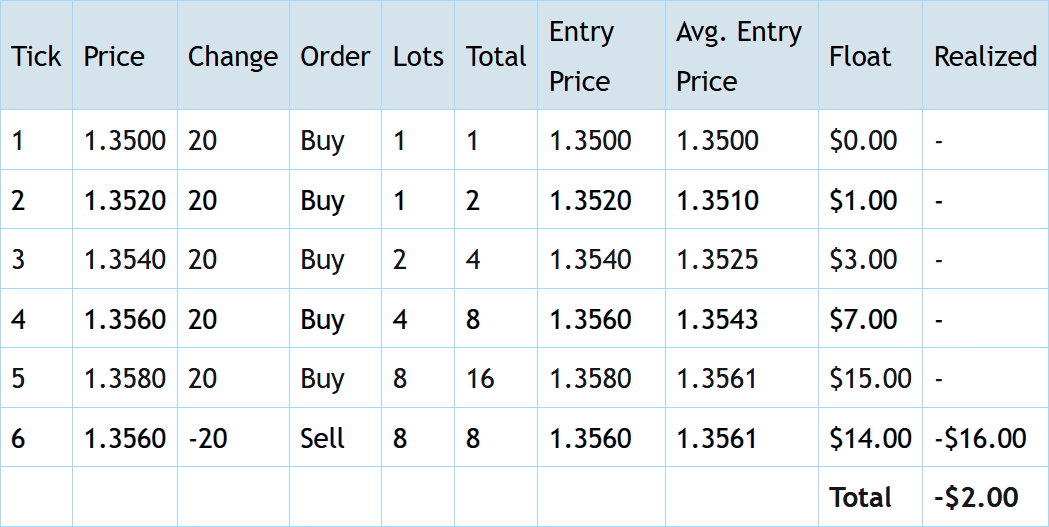
Your average entry price becomes 1.3510.
You keep doubling every time the market moves in your favor by 20 pips.
At tick 6, the price finally drops 20 pips.
According to the Anti-Martingale rule, you must close the most recent (losing) trade.
This cuts your exposure in half — from 16 lots to 8.
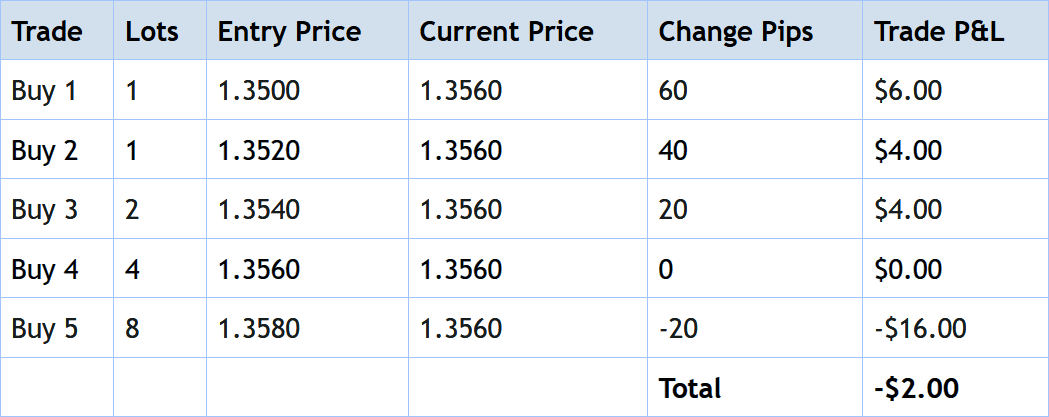
You also took a $16 loss on that losing trade, leaving with a total balance of -$2. The table below shows how this balance is calculated. At tick 6, the profit and loss for each open position looks like this.
One Losing Trade Cancels the Gains
The last losing trade erased all the profit from the open positions and is left with a total loss of -$2. In this system, the total loss for the whole sequence always ends up matching the stop-loss amount.
A single 20-pip move was enough to cancel out the entire group’s profit. After this, four positions are still open. The first three are making money, and the last one is at break-even.
So what should be done with the remaining open positions?
Two Approaches
- Standard Reversal
Some traders believe the trend has reversed at this point.
They close all open positions to protect profits similar to traditional Martingale strategy.
- Hybrid Approach
Others wait to see if the main trend continues, especially if other indicators support it.
In this hybrid method, only the losing trade is closed.
Like Martingale and grid systems, the take-profits and stop-losses here are virtual.
They define only when a trade is considered “winning” or “losing,” not actual exit levels.
Doubling Up Can Backfire
As shown above, doubling your lot size can hurt you as well. In a reverse-Martingale, you increase your size when the market moves your way, but a sudden move against you can quickly erase your profits.
The upside is that your maximum loss in one sequence is capped by the stop loss on your first lot. For example, if your stop loss is 40 pips and you start with 1 micro lot, your biggest loss in a sequence is about $4.
Just as Martingale can recover losses with one winning trade, Anti-Martingale does the opposite. One losing trade after doubling up can remove all the profit from the sequence.
This effect is shown in Tables 1 and 2, where rapid price swings can easily trigger stop losses.
Risk Balance
Martingale and Anti-Martingale have the same basic risk and reward. If your trade picking is only as good as chance, the system has a 1:1 risk-reward ratio and an expected return of zero.
In Anti-Martingale, every losing trade hits its stop loss and wins and losses are equally likely.
So the expected loss is:
E ≈ -½ N × B
where N is the number of trades and B is the fixed loss per trade.
If you take profit after 8 wins in a row, the chance of that happening is (1/2)⁸, so it should occur once every 256 trades. Over 256 trades:
- Expected loss: (½) × 256 × 1 = -128
- Expected profit from the one winning streak: 2⁷ × 1 = 128
- Expected net return: 0
Any other number of required wins produces the same result. In real trading, spreads and fees push the expected return slightly below zero unless your trade selection is better than random.
Avoiding the Drawdowns
The standard Martingale system doubles down on every losing trade. Without proper limits, this can cause huge losses. The reverse Martingale still has losses, but they are smaller. The trade-off is that you won’t get the smooth gains Martingale can offer.
Choosing an Entry Signal
Anti-Martingale works best when your indicator signals a strong existing trend or the start of a new trend. Useful technical tools include:
- Moving averages and convergences
- Volatility squeezes
- Breakouts of key support/resistance
- Chart patterns
- Momentum indicators
- ADX/Elliott Waves
Stronger trend signals increase the chance of profitable trades. Don’t rely on technical indicators alone; combining them with fundamental analysis is safer, though harder to automate.
Results
Short-term performance can be misleading. To study long-term behavior, simulations were run using a random pricing model for different markets:
- Flat (trend=0)
- Bullish (trend=0.1)
- Bearish (trend=-0.1)
An average spread of 4 pips was used. The results are in Table 3.
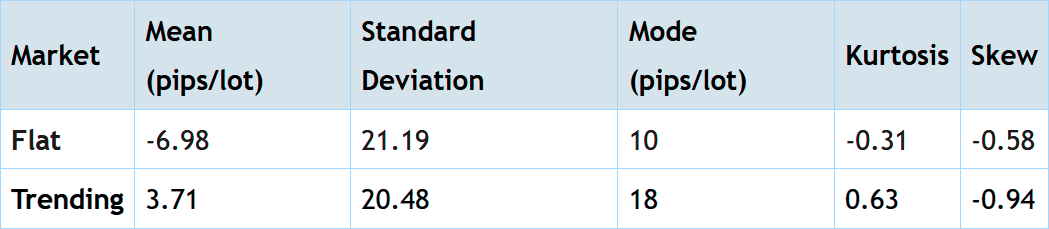
The key point is the big difference in performance. Anti-Martingale does not perform well in flat markets. The average returns are much lower, even worse than random trading. This shows why it’s important to pick the right strategy for the right market.
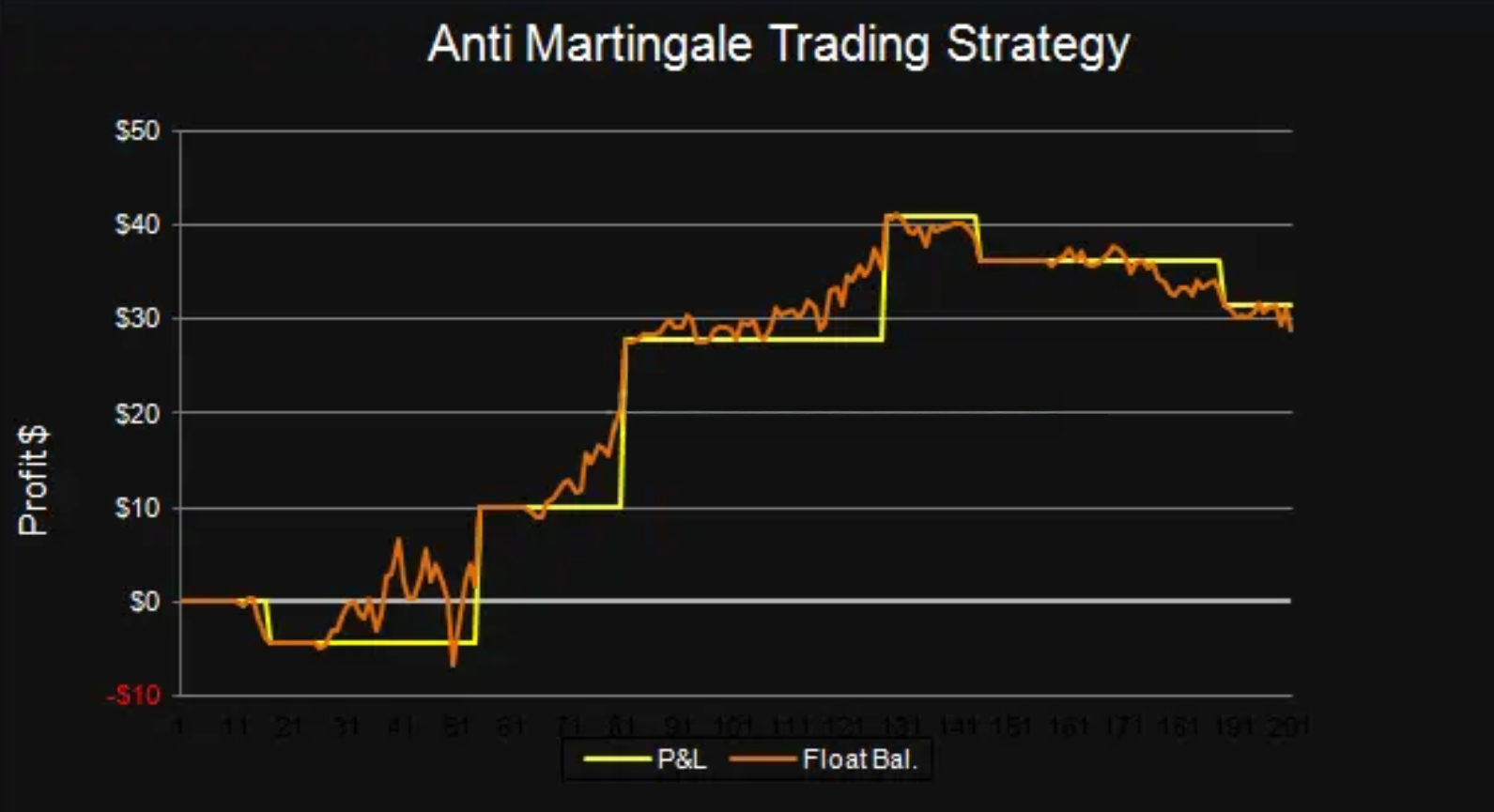
Figure 1 shows a typical profit pattern from one run. Compare this to standard Martingale, where losses happen often and are large.
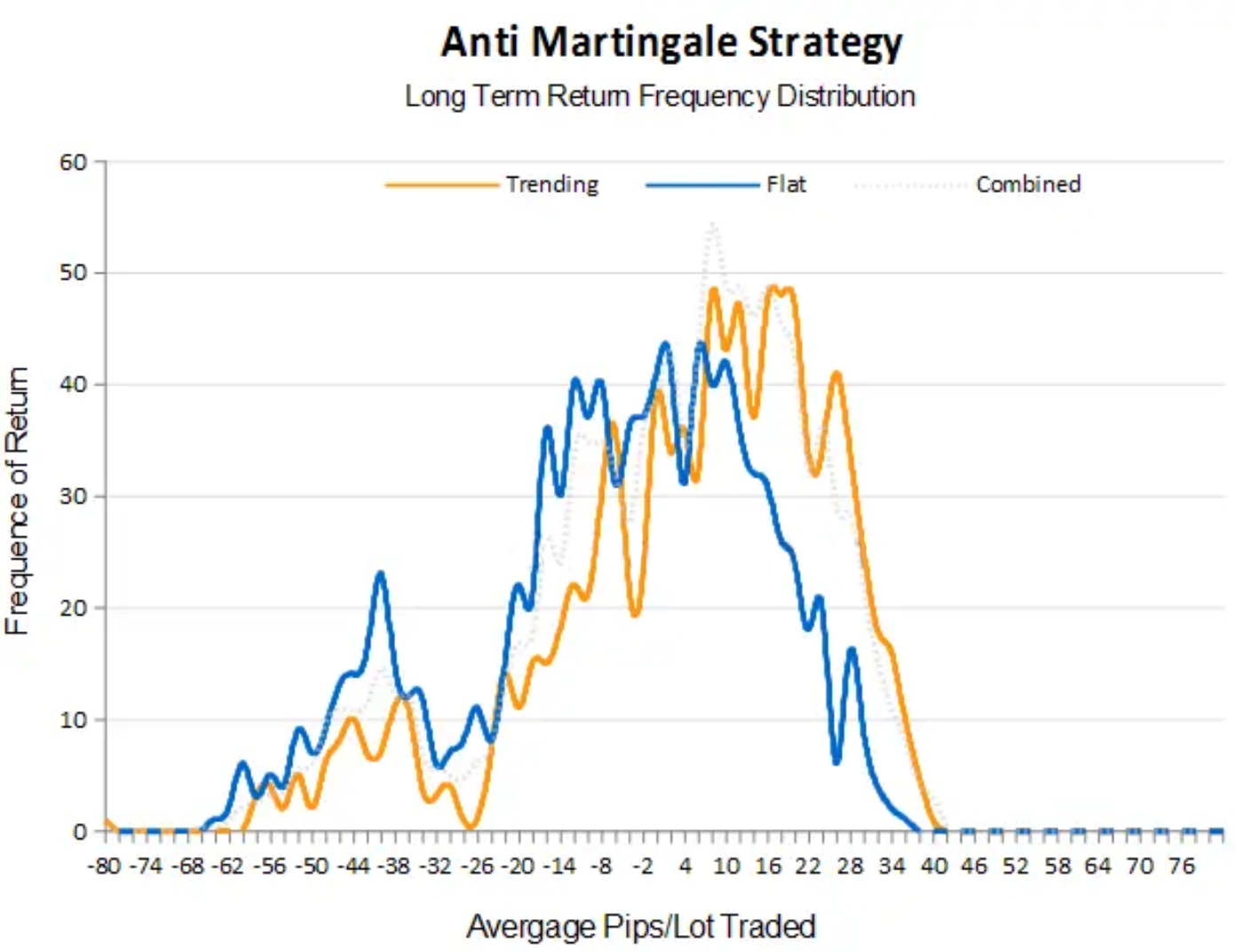
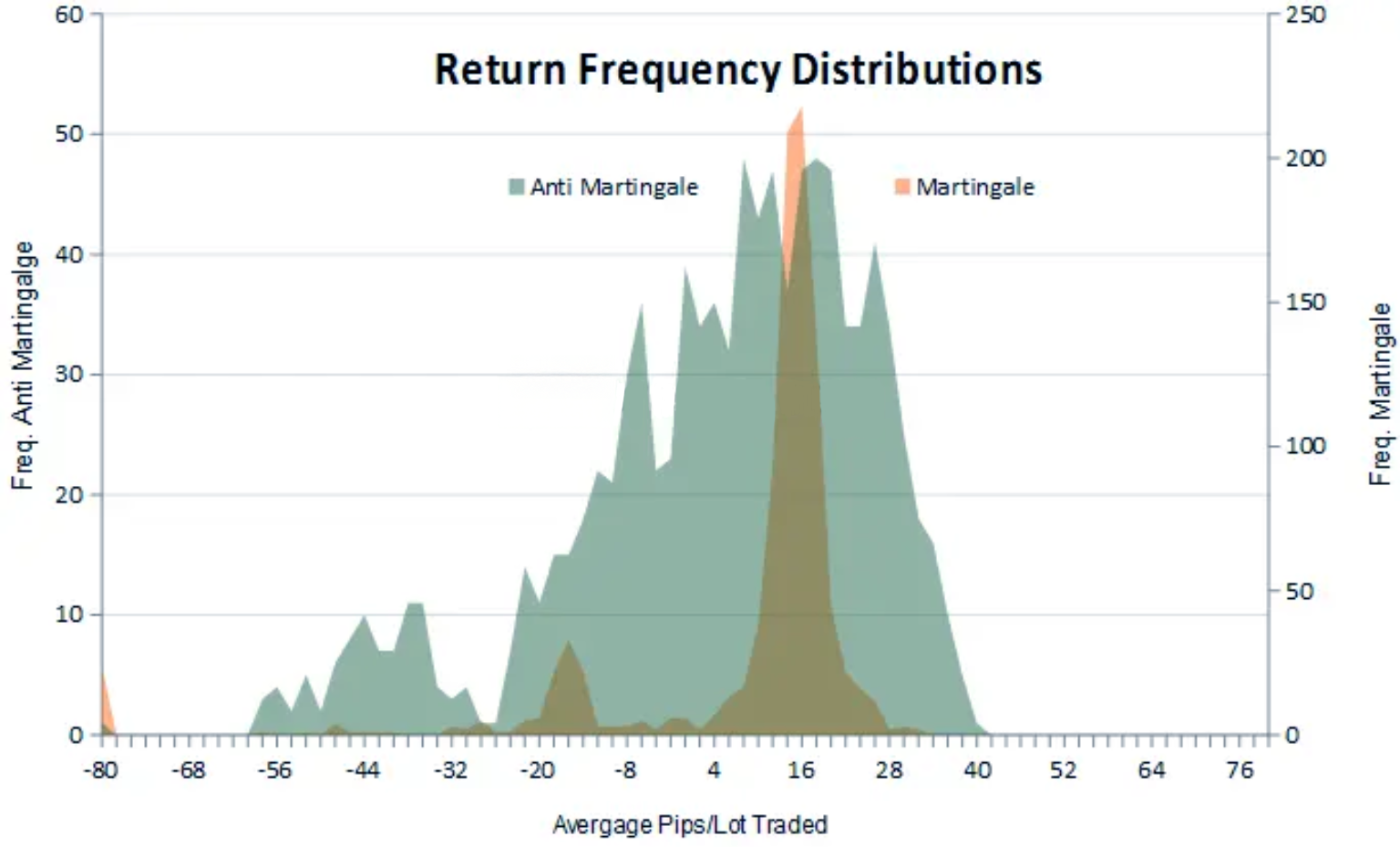
The chart shows the frequency of returns for each market type. Notice that returns for trending markets are shifted to the right, showing higher profits.
Anti-Martingale Works Best in Trending Markets
Martingale and Anti-Martingale should not be used at the same time in the same market.
They behave differently:
- Martingale → best in flat, ranging markets
- Anti-Martingale → best in trending, volatile markets
Because Anti-Martingale builds exposure with the trend, it captures the large moves.
Comparisons
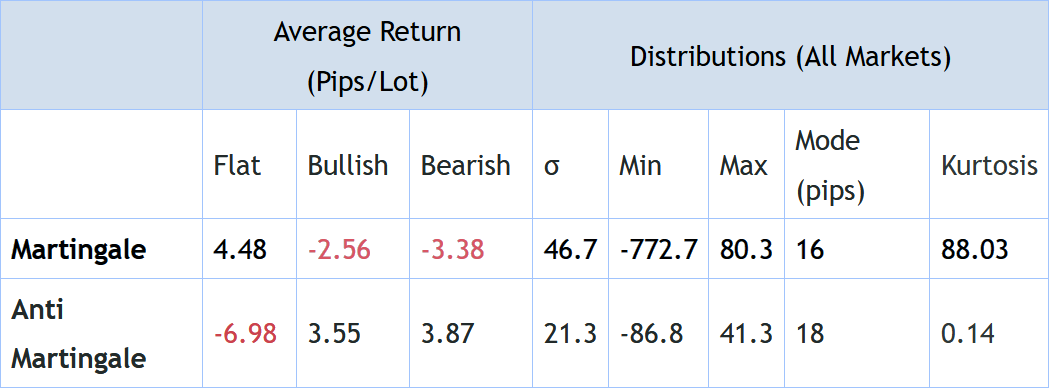
Figure 3 below shows how returns are distributed for both systems. Martingale has a sharp peak with large “fat tail” losses. The worst run lost -772 pips/lot (see Table 3).
Table 4 also shows how performance varies with market conditions. Anti-Martingale performs much better in rising or falling markets. Standard Martingale struggles in these markets because it doubles down against trends, causing heavy losses.
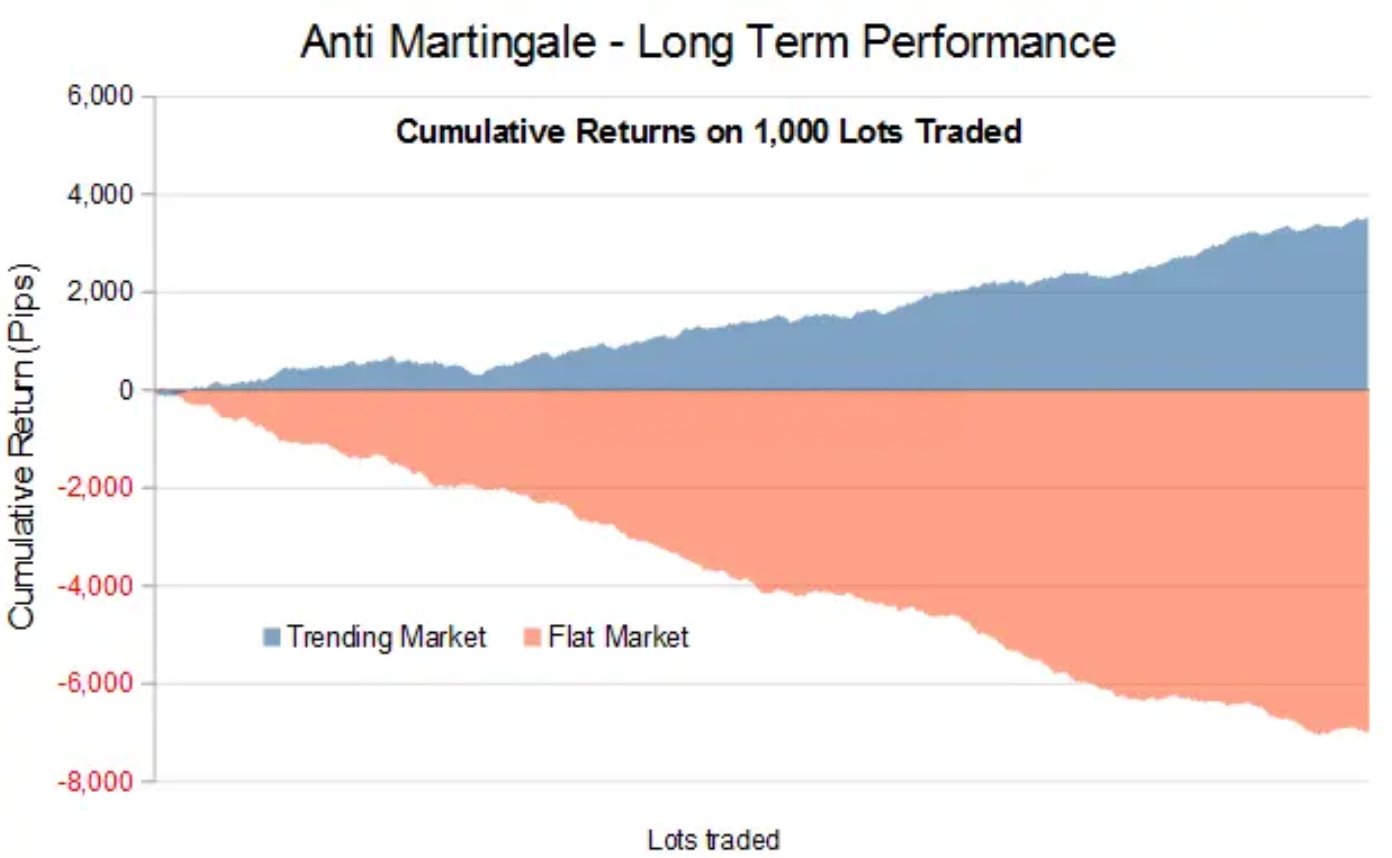
The chart shows cumulative gains for Anti-Martingale are smoother than standard Martingale.
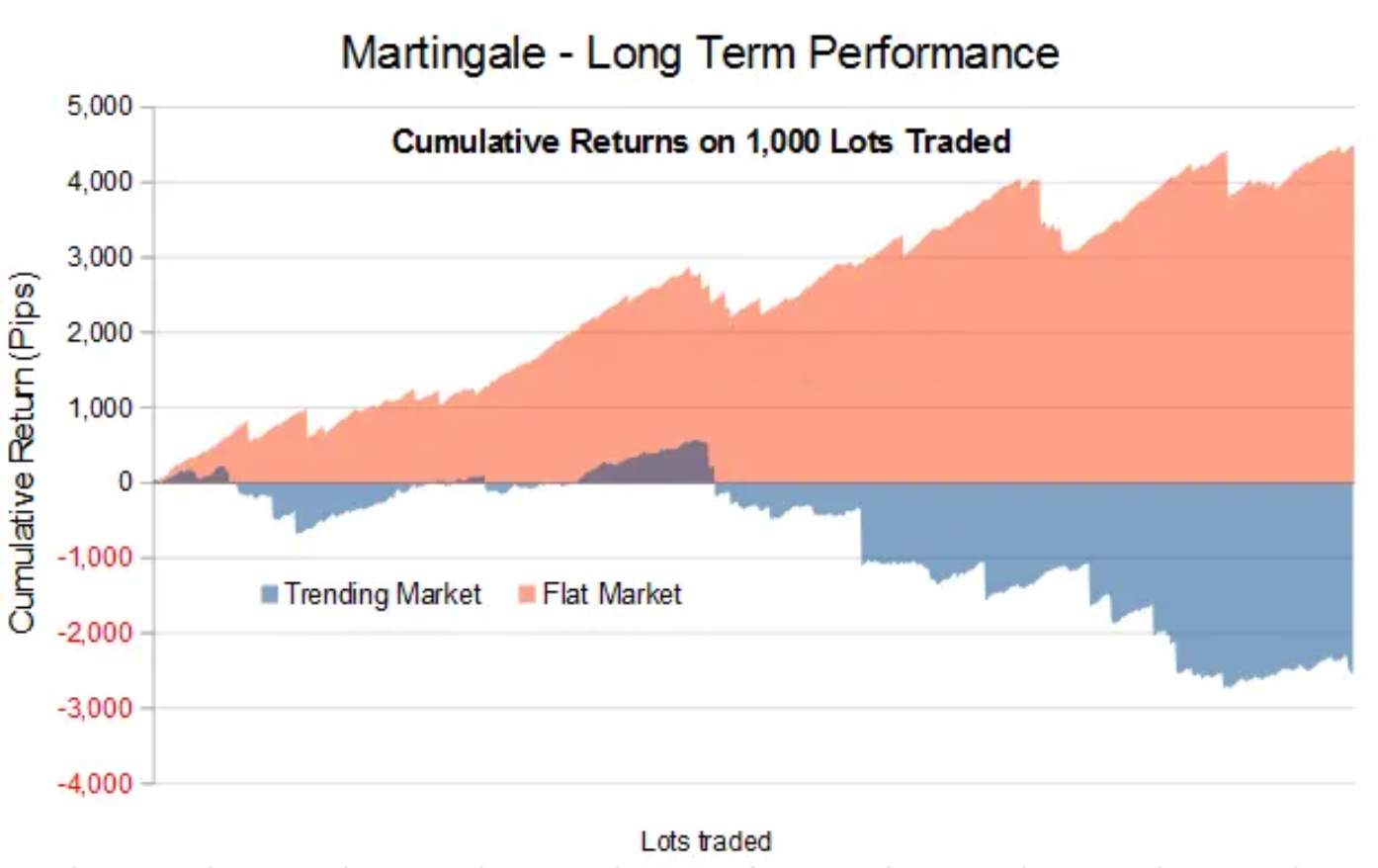
Martingale returns show a “saw tooth” pattern with occasional large, sudden losses, which is typical of the classic system.
Anti-Martingale: Key Points
Conclusion
- Anti-Martingale works best when the market trends strongly
- Martingale works better in flat, range-bound markets
- Both systems have a long-term expected return near zero
- Proper entry signals and market selection are crucial
- Martingale → small gains, rare huge losses
- Anti-Martingale → frequent resets, but safer drawdowns
Switching between the two strategies depending on market conditions can improve results.
Why Traders Like It
- Cuts losses fast and grows winning positions
- Feels more logical than doubling down on losing trades
- Easy to automate
- Avoids exponential drawdowns
- Great for trend-following systems
Why Traders Avoid It
- One losing trade wipes out the entire sequence
- Larger position sizes can still create risk
- Market gaps or slippage can cause losses
- Performance collapses in flat markets
TradingLab is not an investment advisory or a similar financial advisory firm. We provide content based on economic, financial analysis, technical analysis, trading strategies, and other subjects found in economic, financial, and business literature.
Sharpen your Trading Strategies

product+

ABOUT US


Risk Disclosure
Trading involves significant risk and may not be suitable for all investors. Trading with high leverage can result in substantial losses, potentially exceeding your initial investment. Prices can be highly volatile and can be influenced by unpredictable external factors, including financial or political events. Only invest money that you can afford to lose. Past performance is not indicative of future results. It is essential to carefully assess the risks before making any trading decisions. Trading with leverage significantly increases the associated risks. All content provided on the website is for informational purposes only and should not be considered as investment advice or a recommendation.
Intellectual Property
You will fully own all intellectual property rights for any material you submit, whether it be text, source code, algorithms, designs, methods, or any other form. It is your sole responsibility to ensure that the information you submit is free from any third-party claims or restrictions. By submitting this information, you explicitly confirm that you have all the necessary rights to use, manage, and share it.


